
And Why Does It Sometimes Feel Like You Can?
If you’ve spent enough time along the coast in Rosarito, Ensenada, or just about anywhere in Baja, you’ve probably heard it said with confidence:
“In Mexico, all beaches are public.” That statement is not folklore. It’s law.
What the law actually says
Under the Mexican Constitution and the Ley General de Bienes Nacionales (General Law of National Assets), beaches are federal property. More specifically, they fall under what is called the Zona Federal Marítimo Terrestre, better known as ZOFEMAT.
ZOFEMAT refers to the 20-meter strip of land measured inland from the highest high-tide line. That 20-meter band, along with the beach itself, belongs to the nation. Not to a hotel. Not to a private homeowner. Not to a developer.
To put it simply: If your toes are in the sand, you’re standing on federal land.
This means the public has the legal right to access and enjoy Mexican beaches. Period.
In 2020, federal reforms reinforced this principle, explicitly stating that access to beaches must remain free and open to the public. Hotels and private developments cannot legally block entry points or charge fees just to step onto the sand.
So far, so clear. And yet.
Why does it sometimes feel private?
Anyone who has tried to walk “through” a gated beachfront community in Rosarito or Ensenada knows the reality can feel different from the statute book.
Here’s where things get nuanced.
While the beach itself is public, access routes to that beach often run through private property. If the only practical path to the sand crosses a gated development, condominium complex, or hotel driveway, that private landowner controls that specific access point.
They cannot legally deny access to the beach itself.
But they can regulate who enters their private property.
This is where friction happens.
In some cases, businesses may create the impression of exclusivity by installing controlled entry gates, limited parking, or security checkpoints. It can feel like the beach beyond is private, even if legally it is not.
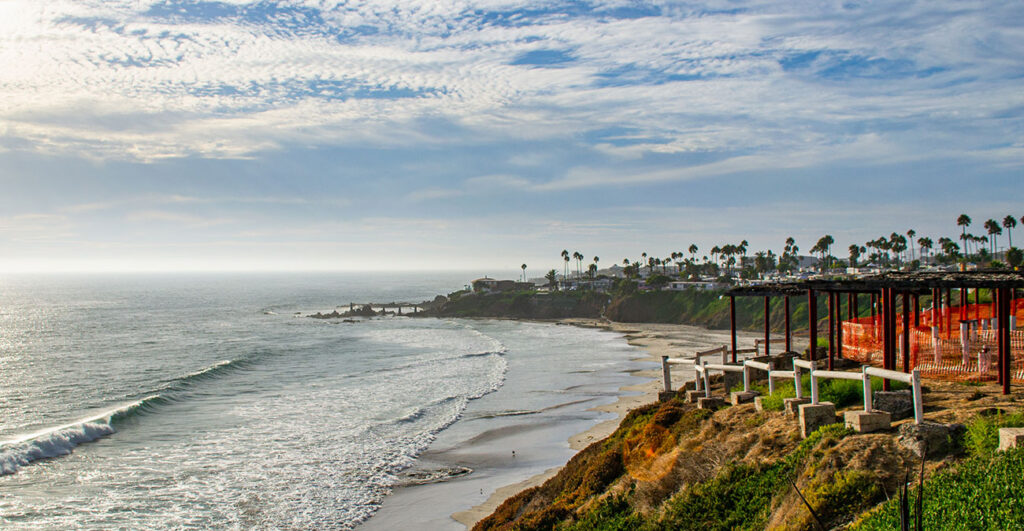
Add to that the natural geography of Baja’s coastline. Cliffs, rocky points, and steep terrain often make public access physically difficult. When a resort builds stairways and pathways down to the sand, it may appear that the beach “belongs” to them simply because they built the infrastructure.
Infrastructure does not equal ownership. But perception is powerful.
What is ZOFEMAT, really?
ZOFEMAT is administered by the federal government through the Ministry of Environment (SEMARNAT). It regulates the use of the 20-meter federal zone adjacent to the ocean, as well as reclaimed land and certain coastal waters.
Private individuals or businesses can apply for a concession or permit to use part of the ZOFEMAT area.
What does that permit allow?
Typically, it allows for:
- Temporary structures such as palapas, beach clubs, loungers, or event setups
- Maintenance and controlled commercial use
- The right to operate certain services (restaurants, rentals, weddings, etc.)
What it does not allow is ownership of the beach.
A ZOFEMAT concession grants usage rights under strict conditions. The concessionaire must pay federal fees, comply with environmental regulations, and maintain the area responsibly.
Most importantly, a concession does not authorize the holder to block public access to the beach.
- They may manage a defined operational zone.
- They may provide services within that zone.
- They may remove their own equipment at night.
- They may not legally say, “This beach is private. Go away.”
So why do some try?
The motivation is not mysterious.
Beachfront real estate commands a premium. A perception of exclusivity increases property values. Hotels market “private beach experiences” because it sounds luxurious. Developers sell tranquility, privacy, and security.
From a business standpoint, limiting foot traffic can feel like protecting an investment.
From a legal standpoint, however, Mexico has been increasingly firm about public access. In recent years, federal authorities have publicly emphasized that beaches are national assets, not gated amenities.
Enforcement, like many things in coastal Mexico, can vary.
The practical takeaway
If you encounter a sign that says “Private Beach,” understand that under Mexican federal law, the sand itself is not privately owned.
If access is blocked, the issue may be about the route, not the beach. Municipalities are supposed to designate public access corridors, but in practice, these can be poorly marked or inconvenient.
For American residents and visitors in Baja, the key is understanding both the letter of the law and the realities on the ground.
Mexico’s coastline belongs to everyone. That principle is deeply embedded in federal law.
What sometimes belongs to someone else is the driveway.
And along Baja’s cliffs and coves, that distinction can make all the difference.
If you’ve had an experience with “private beach” signage in Rosarito or Ensenada, we’d like to hear it. Was it a misunderstanding? A legitimate restriction? Or just creative marketing?
The sand, at least legally speaking, is still yours.