

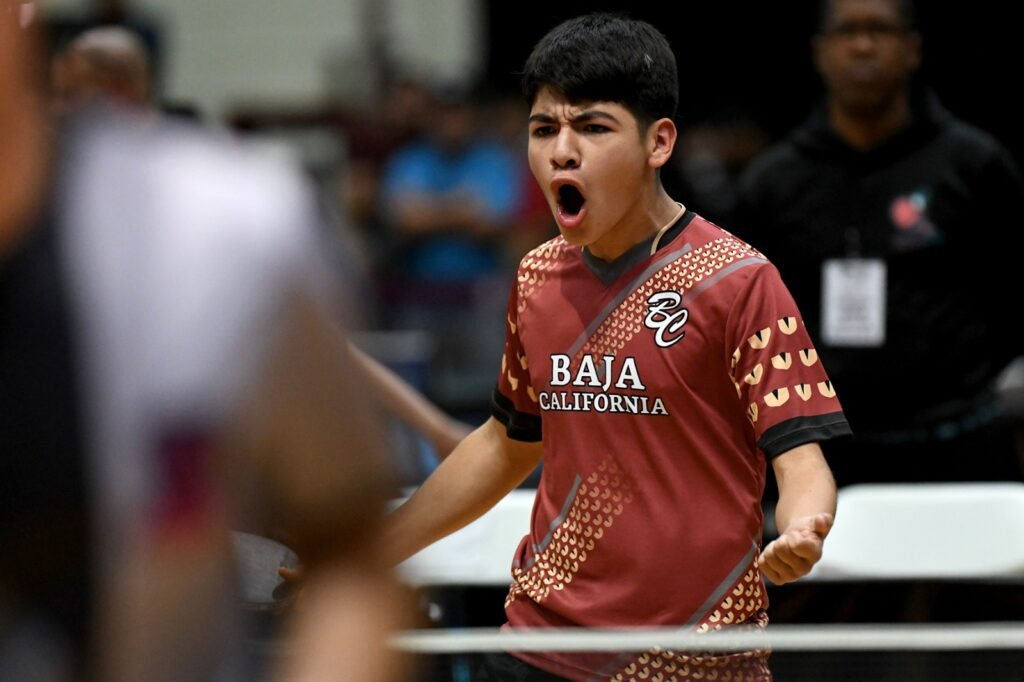
An international tournament with local weight
Tijuana has learned to host international events without fanfare, and this February it does so again, although this time through sport rather than spectacle. From February 4 to 8, the city will host the Mexico Open Table Tennis Tournament alongside the Senior National Selection at the Centro de Alto Rendimiento, an event that quietly places Baja California within the global competitive circuit. While the announcement took place at COTUCO, the significance of the event extends well beyond a press conference, since it forms part of the official calendar of the Federación Mexicana de Tenis de Mesa in coordination with state sports authorities.
Twelve countries have already confirmed participation, including the United States, Colombia, Chile, Guatemala, Costa Rica, Ecuador, Puerto Rico, and the Dominican Republic, with Mexico competing as host. Moreover, more than 225 athletes are registered, several of whom arrive with Olympic experience, which immediately raises the level of competition. For that reason, the tournament is being closely watched by national federations and coaching staff.
What this means for Baja California
For Baja California, hosting this event represents more than visibility. International tournaments validate infrastructure, justify public investment, and create continuity for athlete development, particularly when they repeat year after year. According to federation president Félix Ballesteros, this competition already aligns with the long-term vision toward Los Angeles 2028, which confirms that Baja is not acting in isolation, but rather as part of a broader Olympic pathway shared with the United States.
As a result, the impact extends beyond the court. Sports tourism brings hotel occupancy, restaurant activity, and regional exposure, yet the deeper value lies in positioning Baja as a reliable host for high-level competition. That credibility cannot be improvised and must be earned through execution.

Ensenada’s role in developing talent
Although Tijuana serves as host, Ensenada remains part of the competitive ecosystem. Data from the Instituto del Deporte y la Cultura Física de Baja California, as well as participation records from the Nacionales CONADE, show consistent representation from Baja California in table tennis at the youth and junior levels, with Ensenada contributing athletes year after year. Local coaches often point to discipline and technical training as strengths, even though limited exposure has slowed progression.
However, hosting international tournaments within the state shortens that distance. Young athletes now have direct access to elite competition, which raises expectations and provides clear reference points for development. In that sense, the benefits extend south, even if the matches take place in Tijuana.
Table tennis versus traditional tennis
Despite sharing a name, table tennis and traditional tennis operate under entirely different demands. While conventional tennis relies on endurance, court coverage, and long rallies, table tennis depends on reaction speed, spin control, and instantaneous decision-making. At elite levels, the ball can exceed 70 kilometers per hour across a table less than three meters long, leaving no margin for hesitation.
It is also important to note that table tennis is an Olympic discipline with a structured international circuit, despite receiving less mainstream media coverage. The technical and mental demands rival those of any high-profile sport.
Athletes and the global tennis context
The confirmed roster reflects the tournament’s seriousness. The United States will be represented by Amy Wang and Lucca Lobo, while Mexico fields Rogelio Castro and Aranza Cosío, both of whom competed at Paris 2024. Meanwhile, Emmanuel Otalvaroque, currently ranked second worldwide in the under-11 category, draws attention for redefining how early elite development now begins.
Globally, tennis fans follow Wimbledon, the US Open, Roland Garros, and the Australian Open, while table tennis followers track World Championships, World Cups, Olympic qualifiers, and continental events. With this tournament, Tijuana enters that ecosystem not as a spectator, but as a host.
Baja California is no longer asking whether it belongs on the international sports map. Through events like this, it continues to confirm that it does.
No bad news. Just fast hands and long-term vision.