

If you have ever felt tempted by the idea of buying “gasoline for the whole year” from someone who skips receipts and invoices, this story deserves your attention. And if you think that never happens, just ask Raúl N.
A Routine Stop That Escalated Quickly
Earlier this week in El Sauzal de Rodríguez, a routine patrol turned into a textbook example of why cheap fuel often brings expensive problems. Officers from the Fuerza Estatal de Seguridad Ciudadana, supported by the Secretaría de Marina, Secretaría de la Defensa Nacional, and Ensenada municipal police, spotted a white GMC pickup speeding along the free Ensenada–Tecate highway.
They activated their lights and signaled the driver to stop. Instead, the pickup accelerated.
What Officers Found Inside the Truck
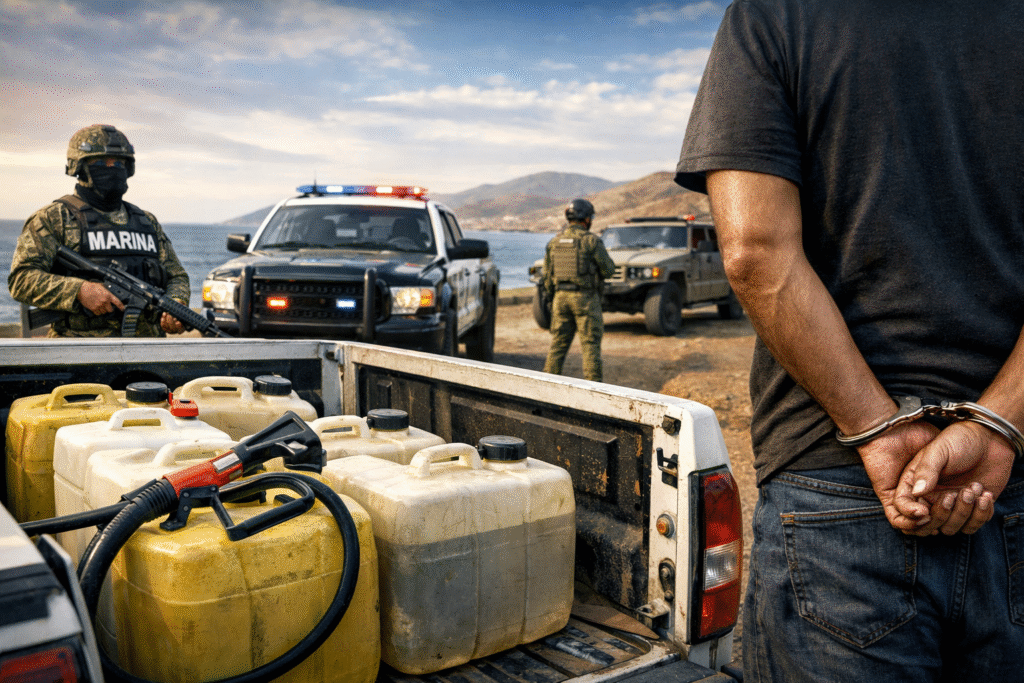
After a short chase through nearby streets, the driver abandoned the vehicle and attempted to flee on foot. Officers caught him only a few meters later. Inside the pickup bed, authorities found fifteen plastic containers. Each one held about 60 liters of gasoline. In total, the load reached roughly 900 liters.
No permits appeared. No invoices surfaced. No documentation existed.

No Paperwork, Big Consequences
When officers asked where the fuel came from, Raúl N., a 31-year-old originally from Jalisco, could not provide proof of purchase. He showed no receipt, no invoice, and no explanation that held together. As a result, authorities turned both the fuel and the driver over to the Fiscalía General de la República, which will now determine the federal charges.
At this point, the case stopped being about traffic violations. It became a federal matter.
Why This Falls Under Huachicoleo
In Mexico, transporting or selling fuel without authorization qualifies as huachicoleo. This crime covers illegal distribution, stolen hydrocarbons, and tax evasion tied to fuel sales. It goes far beyond missing paperwork.
At first glance, 900 liters of gasoline sounds profitable. However, the math tells a different story.
The Numbers Are Smaller Than They Sound
Legal gasoline prices in Baja California currently hover between 23 and 25 pesos per liter. On the illegal market, fuel usually sells cheaper to move quickly. Prices often fall between 15 and 18 pesos per liter.
That puts the estimated gross income from this load between 13,500 and 16,200 pesos. This figure is only an estimate, not an official number. It also excludes transportation costs, containers, time, and risk. Once those factors enter the equation, the profit shrinks fast.
In short, this was not a fortune. It was barely a good weekend.
Why the Impact Still Matters
The real damage appears when this activity repeats at scale. According to data from PEMEX and federal authorities, fuel theft has cost Mexico tens of billions of pesos over the years. Those losses affect public finances, infrastructure projects, and social programs.
Safety adds another layer. Gasoline stored in improvised containers creates serious fire and explosion risks. Communities should never carry that burden.
The Good News in This Story
Here is the positive part. No one suffered injuries. No fires broke out. The fuel never reached unsafe storage or resale points. Authorities coordinated effectively across agencies. The chain stopped early.
And finally, a small smile to close.
After all that running, risk, and effort, the numbers suggest Raúl N. was not chasing a fortune. He was chasing the equivalent of a few legal tanks of gas—plus a federal investigation, included free of charge.
No bad news here. Just one less bad idea driving through Baja.