

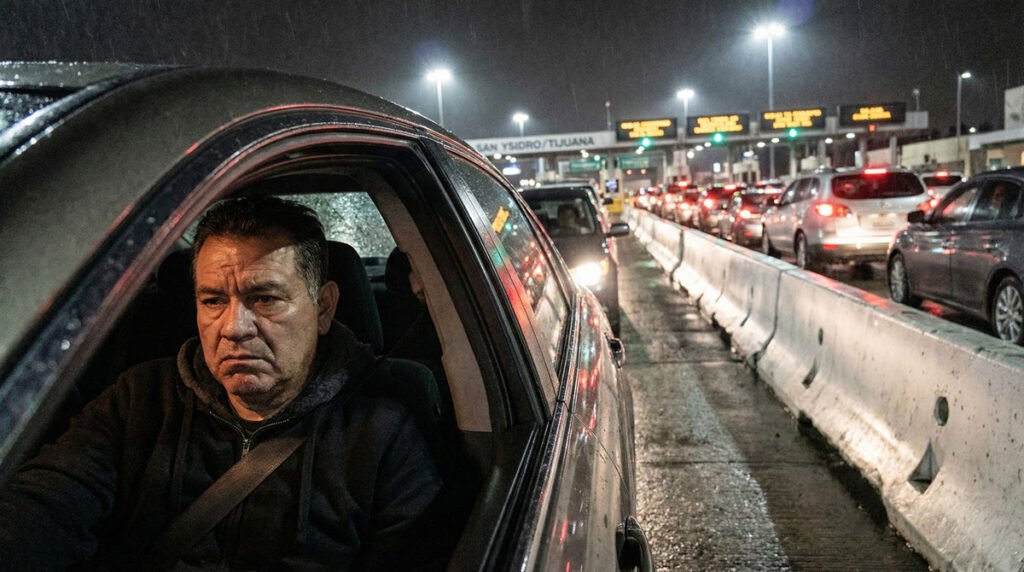
Tijuana just proved something most of us already knew, but it’s always nice when reality bothers to provide receipts. Give transborder workers a chance to buy back time, sleep, and a shred of weekday dignity, and they will stampede toward the signup form like it’s the last chopper out of a zombie movie.
According to SEDETI, the city’s Cruce Ágil program for transborder workers filled its initial pilot cap of 500 pre-registrations in under two weeks, and early reporting tied to the rollout says more than 1,500 people attempted to register within the first 24 hours alone, which is about as subtle a signal as you’re ever going to get that the TJ–San Diego commute has become a daily endurance event rather than a normal act of transportation. The program is now moving into the next phase, where the city begins the physical sticker handoff and the validation of original documents, and officials have already hinted that an additional registration stage could open sooner than planned because the waitlist is long enough to qualify as a modern work of literature.
The logic behind the program, at least on paper, is straightforward in the way only a government plan can be: push commuters into hours when the lanes are usually underused, keep the lane “fast” by limiting access, and measure whether the promise holds once real drivers with real deadlines start showing up. Secretary Pedro Montejo Peterson has framed it as a timing strategy, saying the promoted hours represent a small slice of total crossings, roughly 12 percent, and that those windows match the schedules of people who live in Tijuana and work in the United States, which is a polite way of acknowledging that thousands of families have built their entire lives around alarms that go off when decent people are still dreaming.
SEDETI’s own published guidance lists the program hours in a way that makes the intent clear: San Ysidro’s Ready Lane is tied to midnight to 8:00 a.m. and then 4:00 p.m. to 8:00 p.m., while Otay is positioned as the flexible option with 24/7 availability, and if you’ve ever driven either crossing you already know why that split matters, because “fast” is not a universal concept at the border and different gates deliver different kinds of chaos depending on the day, the mood of the universe, and the mysterious forces that govern brake lights.
Now, about the part where this is basically a subscription to sanity, because the city isn’t pretending otherwise. The fees have been described in terms of UMAs, landing in the 95 to 140 range, and those figures were translated in coverage into peso amounts in the neighborhood of 10,748 to 15,839 a month depending on the tier, which is not pocket change unless your pocket is sponsored by a tech company. It’s also worth remembering that UMA values update annually, so anything pegged to UMAs can shift in pesos from year to year even if the “plan” stays the same, which is the kind of detail that always feels minor right up until your bank account starts asking follow-up questions.
The city’s eligibility rules also remain very clear that this is not an open invitation to improvise. The FastLane requirements published by SEDETI spell out Baja California residency expectations, employment proof for U.S. work, and the necessity that everyone in the vehicle is registered, and they also state that Mexican nationals must show a valid work visa while Green Card holders are listed as not eligible in the program’s published requirements, which is one of those bureaucratic contradictions that makes sense only in a universe where permanence somehow disqualifies you from needing to get home on time.
What makes this pilot more than a flashy announcement, though, is that it’s now a public performance test, because demand is obvious and the city has already demonstrated that people will pay for an alternative to hour-long standoffs with exhaust fumes. CBP’s border wait time postings routinely show that waits can reach painful levels even in the early morning hours that commuters are being nudged toward, and that broader reality is exactly why a paid “fast” option sells so quickly: nobody is buying luxury, they’re buying the ability to live like a person who sees their family while the sun is still up.
So the question for the next few weeks is not whether people want it, because that part has already been answered loudly, but whether the lane stays genuinely fast once it begins operating with verified participants rather than hopeful registrants refreshing a portal. If it performs as advertised, city officials will have the political and financial incentive to expand it, because it becomes a revenue stream tied to border-adjacent infrastructure and a visible win for commuters who have learned to treat time as their most scarce resource; if it bogs down, it becomes just another line with better marketing, and nobody is paying fifteen thousand pesos a month for an illusion.
Either way, the sold-out pilot tells us something important about this region: in a place where life is split between two countries and the commute can devour entire days, speed is no longer a convenience, it’s a quality-of-life policy, and people will line up—ironically—to stop lining up.