

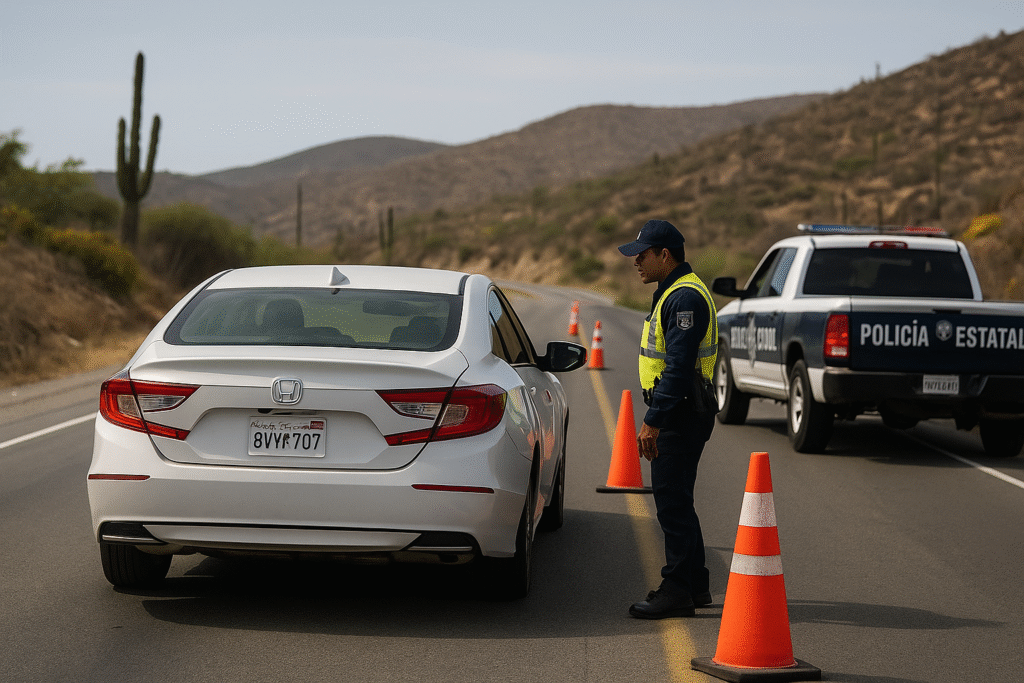
Living in Baja offers sunsets, ceviche, pelicans, oysters, crisp white wine, bold red wine, and even a beautiful totoaba—now recovered thanks to UABC. Yet our roads also bring another familiar sight: foreign-plated vehicles hoping today is not the day an officer studies their stickers.
These cars belong to neighbors, teachers, retirees, and many of our readers. Recently, after a particularly alarming email circulated from a major insurer, one question kept returning:
“Is the regularization program still alive, or are we one traffic stop away from losing the car?”
Because of those concerns, I reviewed decrees, state portals, and more legal pages than anyone should face without wine. Fortunately, the truth is clearer than the panic suggested.
The Program Is Still Active Across Both Bajas
Although early 2024 guidance mentioned a March 31, 2024 deadline, the government later extended the program. In late 2025, a new federal decree pushed the regularization period to November 30, 2026, and Baja California Sur confirmed the same direction soon after.
Therefore, if you live in Baja California or Baja California Sur, the path to legalizing your foreign-plated vehicle remains open.
The Cost Remains Surprisingly Low
While many prices rise—rent, tacos, gas, everything—the federal regularization fee remains:
MX$2,500 pesos.
This amount appears unchanged in state and federal guidance. Of course, you must also cover broker fees, plates, and state charges. Consequently, most drivers pay $6,500–$10,500 pesos total.
Still, this is far less than losing a vehicle or paying a heavy fine. In Baja, that counts as a small bureaucratic miracle.
More Vehicles Qualify Than Before
Initially, the decree accepted only VINs beginning with digits 1–5. However, later updates expanded eligibility. Under current rules:
- Vehicles must be model year 2017 or older.
- They must have entered Mexico before late 2021.
- Luxury brands are excluded.
- Salvage titles face restrictions.
- VINs beginning with letters may qualify if other conditions are met.
- The car must not appear in theft databases.
In simple terms:
If your car is 2017 or older, clean, legal, and already sunburned under our Baja skies, it likely qualifies.
Once you regularize, remember that you must insure your vehicle properly. At minimum, liability coverage is required. And yes—Bernie at Bernie’s Insurance remains our reliable go-to for residents seeking straightforward guidance instead of stress.
Why That Insurance Email Created Chaos
Many residents received messages claiming that permanent residents cannot legally drive foreign-plated vehicles in Mexico. Although this interpretation comes from national customs law, it applies specifically to vehicles imported under a TIP (Temporary Import Permit).
However, Baja California and Baja California Sur do not use TIPs for most foreign-plated vehicles. As a result, the sweeping rule cited in those emails does not reflect the everyday legal structure in our region.
Still, insurers issue these warnings to protect themselves. If a serious accident occurs, they do not want customs questioning the vehicle’s legal status. Consequently, the safest move for them is to warn everyone at once.
Even so, the panic that followed was understandable.
Should You Be Worried? Enough to Take Action
Although Baja officers usually focus on drunk driving, speeding, or distracted driving, irregular vehicles may still be impounded in cases involving:
- Altered or suspicious VINs.
- Theft database alerts.
- Significantly expired U.S. registration.
- Unresolved past violations.
Therefore, the recommendation is not “don’t worry.”
Instead, it is “regularize before someone else makes the decision for you.”
The program exists so you can avoid problems. Use it while it remains open.
What If Your American Car Has Valid U.S. Plates?
This scenario depends on your immigration status.
Tourists and Temporary Residents
They may legally drive their U.S.-plated vehicles in Baja as long as the plates and U.S. registration are current.
Permanent Residents
Here the rules change. The law focuses on residency status, not nationality. Consequently, permanent residents should not drive foreign-plated cars indefinitely, even if their plates are current. Baja’s TIP-free environment adds flexibility, but it does not eliminate the underlying restriction.
Because of this, permanent residents have three realistic long-term options:
- Buy a Mexican car.
- Import their U.S. car.
- Regularize under the decree—if eligible.
Anything else remains a gray zone with real, if unpredictable, consequences.
To Understand the Law, Reverse the Roles
Imagine a Mexican citizen living in California with a green card. They are driving a Mexican-plated car with outdated registration. When a California officer pulls them over, the result is immediate:
- A citation is issued quickly.
- Penalties can reach $500 USD.
- The vehicle may be towed if registration is long overdue.
No one says, “Lots of people do this. Don’t worry.”
The law exists, and it is enforced.
Similarly, Mexico expects vehicle compliance. The main difference is the degree of enforcement, not the legal foundation.
Consequently, we should not eliminate fear. We should simply channel it toward legal solutions.
Regularizing Still Costs Less Than One Bad Day
A single fine in Mexico can reach $4,000 pesos.
In California, registration penalties can cost hundreds.
A tow can cost even more.
Meanwhile:
Regularization costs MX$2,500 pesos (federal).
A reasonable person sees the math. A Baja resident sees the blessing.
Importing a Newer Car: Legal but Expensive
If your car is too new for regularization—like a 2020, 2022, or 2025 model—the only legal path is importación definitiva. And yes, it is absolutely possible. However, it is costly.
Under importation rules, you must pay:
- 10% Import Tax (IGI)
- 16% VAT (IVA)
- DTA Fee
- Customs broker fees
- Transport and inspection costs
- Plates and state fees
Cost Example for a $30,000 USD Car (2025):
- $3,000 IGI
- $4,800 IVA
- ~$24 DTA
- ~$300–$500 broker
- Additional local fees
Total: $8,200–$8,600 USD
A $50,000 USD vehicle can exceed $14,000 USD in importation costs.
This is why many residents choose to buy a Mexican car or regularize an older U.S. car instead.
What Should Permanent Residents Do?
Here is the honest hierarchy:
1. Best option: Buy a Mexican vehicle. Legal, simple, peaceful. (2018-2026)
2. Second option: Import your U.S. car. Expensive but fully valid.
3. Third option: Regularize an older car under the decree. Affordable and practical.
Driving indefinitely with U.S. plates as a permanent resident remains a gamble. Some people win that gamble for years. Others do not.
Final Thoughts From My Desk to Yours
To everyone across Baja—Ensenada, Rosarito, Tijuana, Mexicali, La Paz, Los Cabos, Loreto, and Mulegé—this is your home. Your car takes you to work, vineyards, oyster bars, schools, taco stands, and sunsets that never disappoint. Because of that, it deserves the same legal clarity your residency requires.
Regularizing or importing protects you, your passengers, and your investment. It also reduces anxiety during every unexpected checkpoint. And once your status is legal, remember to insure properly. Bernie at Bernie’s Insurance can guide you through that step without drama.
Thank you to Wesley and others whose questions inspired this piece. Keep them coming. I’ll keep reading decrees so you can enjoy sunsets, ceviche, pelicans, oysters, wine, and a fully legal car.
No Bad News. Just the truth.


Are there more options for Permanent Residents, for those who still need to regularly drive back and forth between the border? Your 3 options are all becoming a MX plate car, but can that MX plate car driving back to US ? What are the procedure and requirements for a MX plate car driving back to US, these are very rarely covered, hope you can have another article covering that?
Hi Tony,
Thank you for taking the time to write and for raising such an important point. You’re absolutely right — simply saying “get Mexican plates” doesn’t fully answer the reality for Permanent Residents or anyone who needs to cross the border regularly.
We appreciate you flagging this gap. Yes, we’ll be working on a follow-up article that specifically covers driving a Mexican-plated vehicle into the U.S., including what typically happens at the border, what documents may be requested, and when a simple crossing can start to look like an import situation.
Thanks again for reading and for helping steer the conversation toward the questions that really matter.
Hello,
Thank you for a very informative and clarifying article. I am a permanent resident residing about 6 months/year in La Paz, Baja Sur.
Based on all that is happening regarding car registration and plating, I will be driving my later model US plated car back to the US before the November deadline. Do you know of, or have any suggestions for documentation to carry on the drive back that I might need to prevent confiscation of the car during the road trip back north? Such as a letter from a notario stating that I am simply returning the car to the US? Or…?
Thanks much for any thoughts.