


Cold Fronts Arrive Before Sunrise
The cold slipped into Baja before sunrise, quiet but determined. You could feel it on car doors, in the sting on your fingertips, and in the hesitation of every dog waiting at the doorway. The air carried that familiar winter stillness, the kind that makes the kettle louder and the street strangely calm.
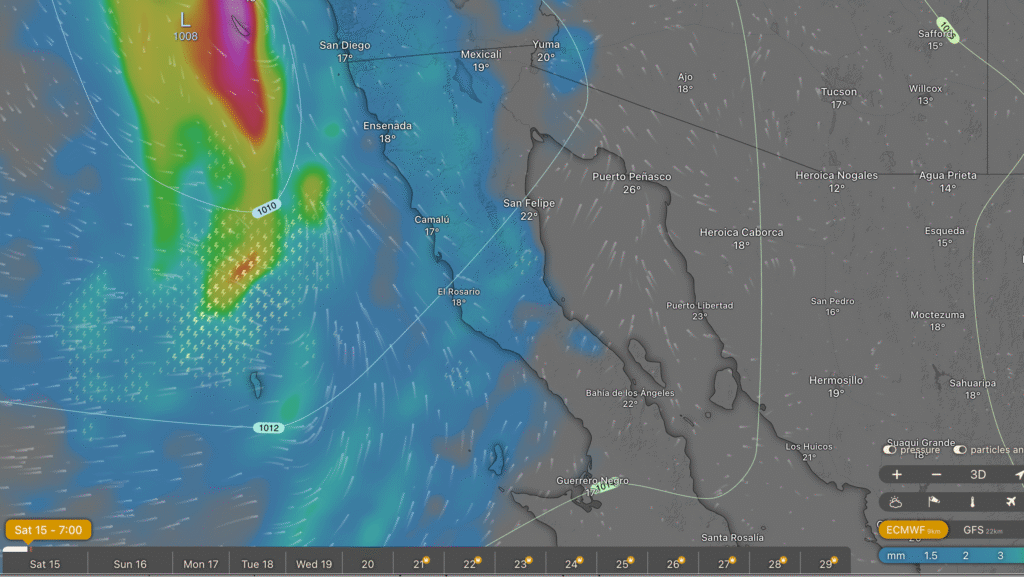
By mid-morning, Protección Civil was already fully awake. Radios buzzed nonstop, trucks rolled out, and someone pointed at a weather map with the intensity of a telenovela villain. Cold fronts 14 and 15 had entered the region, forcing every coastal city to prepare for several days of rain, gusty wind, and those sharp drops in temperature that make even Mexicali rethink its confidence.
While Tijuana, Rosarito, Ensenada and Tecate handled intermittent rain, Mexicali fought dry gusts that lifted dust like restless spirits. Farther south, San Pedro Mártir flirted with the idea of aguanieve, which sounded charming until you remembered the wind always finds your face first.
Still, nothing felt alarming. Baja just shifted into a colder version of itself.
Climate Change Moves the Goalposts
As I mentioned in an earlier article this season, “Brace Yourself, Baja: The Cold Front Is Here” in ways that locals notice immediately. Old-timers with sharp instincts can smell the soil before rain. Many of them told me the same thing this week: “Esto antes no pasaba así.”
And they’re right.
Ocean temperatures have changed. Storms linger longer. Cold fronts drop deeper. Winds feel different, almost metallic. This doesn’t mean we’re heading for anything catastrophic, but it does mean our region is adjusting to new patterns.
Whenever the weather feels “strange,” it usually isn’t. It’s just the atmosphere rewriting its routine, one cold front at a time.
The Night Baja Borrowed the Northern Sky
Then the lights appeared.
Real auroras touched Baja’s horizon for several hours during the geomagnetic storm. People in Mexicali stepped outside and froze mid-movement when they noticed a faint green sheen rise above distant rooftops. In La Rumorosa, drivers pulled over and stared in silence. Someone in Tecate nearly dropped their phone because the sky shifted from dark red to soft violet.
These weren’t filters. They weren’t “enhanced exposures.” They weren’t cuatro ediciones de Lightroom stacked on top of each other. They were actual auroras, visible only because the storm reached an intensity rarely felt this far south.
Of course, this moment invited the usual chaos.
The Rainbow Tricksters
The next morning, social media exploded. Suddenly, daytime rainbows became “Baja auroras.” Influencers posted dramatic captions. Tíos on WhatsApp forwarded images with philosophical messages. Even a few creative souls uploaded a neon-colored arc that looked more like a unicorn sneeze than atmospheric science.
So here’s the quick guide, for the sake of everyone’s dignity:
Real Aurora:
Moves slowly. Glows in soft waves. Appears at night. Never forms a perfect arc.
Disguised Rainbow:
Shows up after rain. Perfect curve. Sun behind you. Occurs in broad daylight. Static and obedient.
Arcoíris lunar (moonbow):
Very pale. Appears at night. Needs strong moonlight and moisture. Rare, but never dramatic.
If your cousin insists his 3 p.m. rainbow was an aurora, please send him this article with cariño.
A Cold Morning in the Valle
Meanwhile, the Valle de Guadalupe woke up with a completely different charm. Cold mornings in the vineyards have a distinct personality. The soil releases a soft, earthy scent that mixes with wet leaves. Vines look darker, almost serious, as if preparing for a long conversation. Every footstep on gravel sounds crisp, fuller than usual because the humidity deepens each sound.
Today is the 12th Viñada de Don Tomás, and the weather decided to be part of the mood. A light breeze moved through the fields. Clouds drifted low, brushing the hills in slow, silver strokes. The cold carried that beautiful sensation you only get in the Valle: a mix of wood, rain, and grape skin.
Why the Viñada Never Cancels
The organizers never panic. They arrived early, checked heaters, polished glasses, and laughed at the annual tradition of people asking if “this year” the weather will force a cancellation. It never does. The Valle knows how to handle winter. Cold air makes the wine smell deeper. Rain on the soil brings out aromas that remind you of the first storm of the season. A glass of Cabernet in this weather feels like holding a small ember.
If someone is using the weather as an excuse to skip Don Tomás today, esa persona no entiende el Valle.
No Bad News, Even in the Cold
This week brought cold fronts, light shows, confused rainbows, stubborn winds, and a beautiful event in the Valle. It felt strange sometimes, but never unpleasant. Baja does winter in its own way, with style, humor, and unexpected cosmic surprises.
And, as always, No Bad News.


1 Comment